
AGV K5 vs K6 vs K7: How AGV's Top Road Helmet Evolved
Published 30 July 2026
AGV's flagship road helmet has been through three distinct generations, and the model numbers alone don't tell you what actually changed. To be precise about what 'flagship' means here: AGV's actual top-of-range model is the race-only Pista GP-RR, worn on the MotoGP grid. K5, K6 and K7 are a rung below that, built specifically for the road rather than the track, and it's within that road-focused K-series that they're the flagship. K5 and K5-S, K6 and K6-S, and the newly launched K7 all still turn up for sale at once, so it helps to know the real differences before you pick one.
Here's the generational story, checked against SHARP (sharp.dft.gov.uk), the Department for Transport's Safety Helmet Assessment and Rating Programme, which retests helmets at higher impact loads than the legal minimum and publishes a plain 1 to 5 star score. Star ratings, weight and shell data below are published there under the Open Government Licence.
The lineup at a glance
One table, so you are not hunting through three separate ones for the same numbers. Everything below comes straight from SHARP.
Plain, non-S versions of K5 and K6 have largely disappeared from current stock, both superseded by their 'S' successors, so live prices below start from K5-S and K6-S rather than K5 and K6.
| Model | SHARP rating | Weight | Shell | Fastening | Sun visor |
|---|---|---|---|---|---|
| AGV K5 | 4 stars | 1.39kg | Composite fibre | D-Ring | Yes |
| AGV K5-S | 4 stars | 1.47kg | Composite fibre | D-Ring | Yes |
| AGV K6 | 5 stars | 1.23kg | Carbon | D-Ring | No |
| AGV K6-S | 5 stars | 1.2kg | Composite fibre | D-Ring | No |
| AGV K7 | 5 stars | 1.6kg | Composite fibre | Quick Release | Yes |


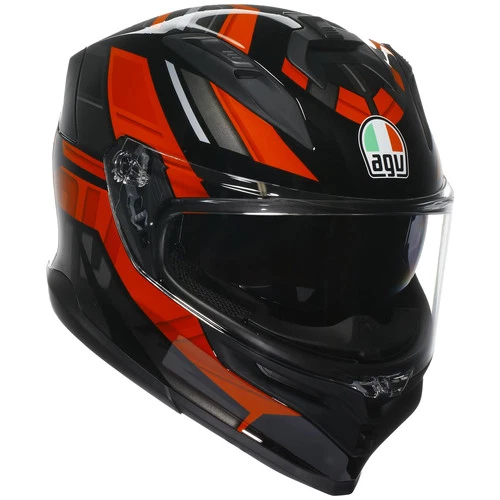


K5 to K6: the material change
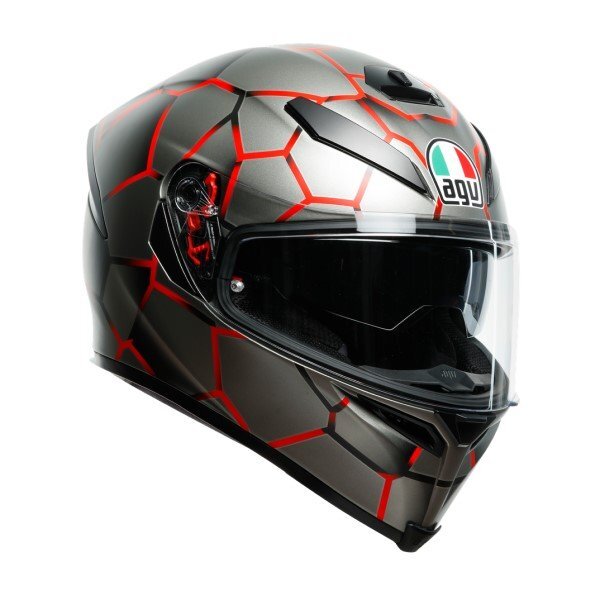
K5 and K5-S are the helmets K6 effectively replaced as AGV's flagship road lid. K5-S added a nicer comfort liner and a drop-down sun visor over the standard K5, both scoring 4 stars on SHARP on a composite fibre shell.
K6 moved to a full carbon shell, which is both lighter and pushed the SHARP score up a full star, to 5. The catch is that K6 (and K6-S) gave up the internal sun visor that K5 and K5-S both have, so anyone who relies on one for filtering low sun on a commute loses a genuinely useful feature moving up the range.
K6 to K7: the sun visor comes back
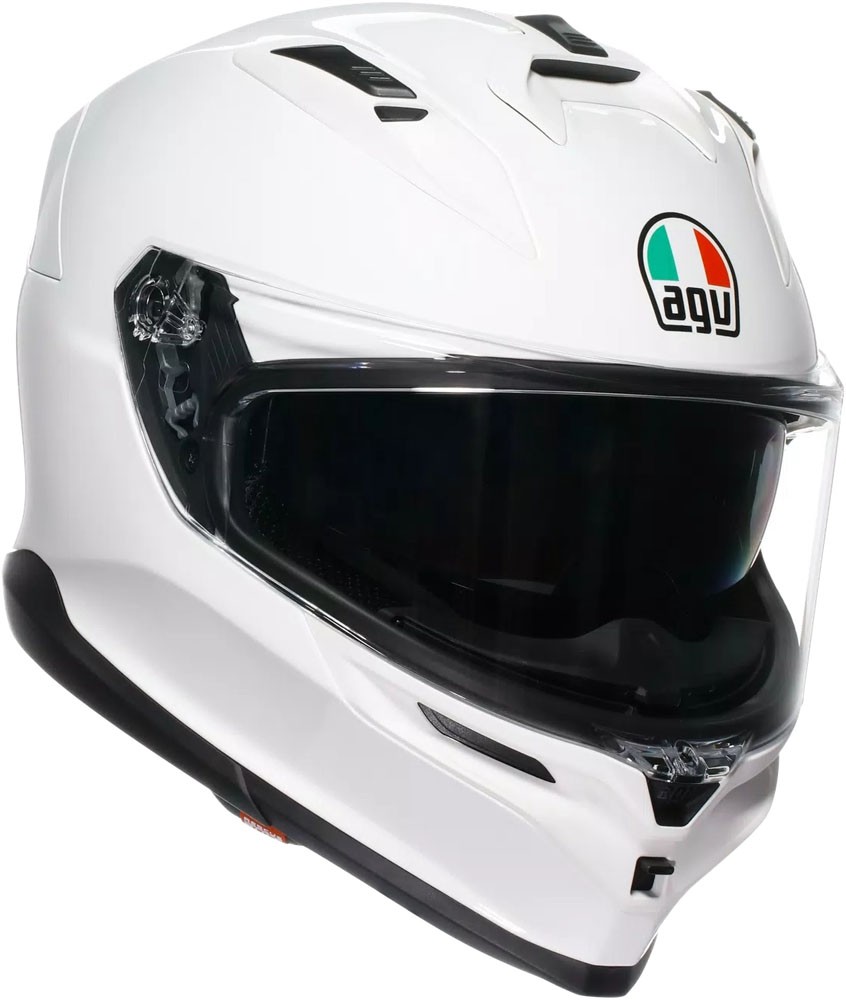
K7, AGV's newest helmet, launched in 2026, is pitched as the sport-touring heir to this lineup rather than a straight replacement for K6-S. It brings back the integrated sun visor riders kept asking for after AGV dropped it from K6 and K6-S, uses a wind-tunnel-developed shell, and matches K6-S's 5-star SHARP score. The trade-off is weight: K7 comes in noticeably heavier than K6-S despite its composite shell, largely down to the added visor mechanism and its extra shell size options. K7 also breaks with the rest of this lineup on the chin strap: K5, K5-S, K6 and K6-S all use AGV's double D-ring, while K7 switches to a quick-release buckle instead.
Fit: the shell shape has stayed fairly consistent
Head shape is one thing AGV hasn't changed much across this lineage, which is useful to know if you're upgrading within the range. K5-S is built around an intermediate oval shell with soft, generous padding that reviewers say fits firmly without distorting your face. K6 tightens things up: it fits snug front-to-back with slightly more room at the temples, suits a medium oval head best, and AGV offers it across four shell sizes so smaller heads aren't left with an oversized shell and thick padding to compensate. K7 keeps that tighter, more compact feel, reviewers describe it as intermediate oval and just on the right side of cramped, which is part of how it controls weight despite the returning sun visor, with interchangeable cheek pads if you need to fine-tune the fit further.
Noise and Pinlock, generation by generation
None of these three is a loud helmet, but reviewers do rank them slightly differently. K5-S comes in as roughly average for noise, with some wind rush around the lower chin bar that earplugs take the edge off. K6 gets consistently better reports off the back of AGV's wind-tunnel work on the shell, with several reviewers specifically noting it isn't excessively noisy even without earplugs in. K7 lands in a similar place to K6, described as very solid on noise, not library-quiet but not offensively loud either, with a smoother rushing sound rather than a whistle, and an average of around 100dB in one formal test.
Pinlock comes included as standard across all three, unlike AGV's cheaper K1: K5-S ships with a clear Pinlock 70 insert, K6/K6-S includes an optically clear insert with no distortion, and K7 steps up to a wider Pinlock 120 insert for a bigger field of view. Whichever generation you land on, you shouldn't need to budget for an anti-fog insert on top.
Composite fibre vs carbon: what K6's shell swap actually buys you
The K5-to-K6 story above is about AGV's own generational choices; it's worth separating that from the general physics of carbon versus composite fibre, since the two get confused. Composite fibre shells are woven fibreglass, often blended with aramid (Kevlar), set in resin. Carbon fibre is stiffer and lighter than fibreglass for the same shell thickness, which is why a carbon shell can shed weight without simply making the shell thinner and weaker. The trade-off is that carbon is more brittle than a fibreglass composite: it resists bending right up to the point it fails, rather than flexing progressively, and it costs more to mould well.
That's the trade AGV made with K6: dropping to a full carbon shell cut real weight (1.23kg versus K5-S's 1.47kg) and lifted the SHARP score by a full star, but K6-S then moved back to a composite fibre shell at an even lower weight (1.2kg) while keeping the same 5-star score, which shows carbon isn't a strict upgrade over a well-engineered composite layup, it's one route to a lighter shell among several. Whichever shell material a helmet uses, SHARP's star rating is the one number that actually tells you how it performed in testing, so treat 'carbon' as a manufacturing choice worth knowing about, not a safety guarantee on its own.
Which one should you actually buy
Pick K5-S if you want the lowest price and do not mind the lower SHARP score, or you specifically want the sun visor without paying flagship money. Pick K6-S if you want the lightest helmet AGV makes and a 5-star score, and you are happy without a sun visor. Pick K7 if you want the sun visor back on a current shell design, and are willing to carry a bit more weight for it.
One caveat that applies to all three: SHARP isn't beyond criticism. A 2009 University of Birmingham study by Nigel Mills argued its rotational-impact test rests on a flawed mechanics model, and manufacturers like Arai have long favoured SNELL's separate test regime over SHARP's for exactly that reason. None of AGV's road-focused K-series carries a second certification like SNELL, so the SHARP score is the only independent safety check available here, a strong, government-run data point, but not the whole picture. SHARP's own page for each model (sharp.dft.gov.uk) breaks the headline star down zone by zone if you want to look past the single number yourself.
Frequently asked questions
Is a 5-star SHARP rating actually safer than a 4-star one?
SHARP tests every helmet at higher impact speeds than the legal ECE minimum requires, across a fixed set of head zones, and the star rating is a direct read-out of how well it performed. A 5-star helmet demonstrably absorbed more of those impacts than a 4-star one did in SHARP's own tests, so within the scheme, a higher star count does mean better measured protection. Fit still matters more than any star rating, but between two helmets that both fit you well, the higher score is the safer choice on the evidence.
Is SHARP's star rating the final word on helmet safety?
No, and it's worth knowing why. A 2009 University of Birmingham study by Nigel Mills argued SHARP's rotational-impact test rests on a flawed mechanics model, and manufacturers like Arai have long favoured SNELL's own test regime over SHARP's, partly because the two weight impact zones differently. None of AGV's road-focused K-series carries a second certification like SNELL, so SHARP is the only independent check available here, still a strong, government-run data point, just not the whole picture. Check SHARP's own per-model page (sharp.dft.gov.uk) for the zone-by-zone breakdown behind the headline star if you want more than one number to go on.
Why did AGV remove the sun visor from K6 and K6-S?
AGV built K6 around a full carbon shell specifically to cut weight, and dropping the internal sun visor mechanism was part of that weight saving, alongside the material change itself. It's a deliberate trade-off for the lightest helmet in the range, not an oversight, which is exactly what K7 then reversed for riders who missed it.
Is the AGV K7 better than the K6-S, or just different?
Mostly different. Both score 5 stars on SHARP, so neither is the 'safer' choice on that measure. K7 adds the sun visor back and a newer shell design, but is noticeably heavier than K6-S. If you want the lightest helmet AGV makes, K6-S still wins; if you want the sun visor and don't mind extra weight, K7 is the newer, better-equipped choice.
Has the head shape changed much between K5, K6 and K7?
Not dramatically. All three are built around AGV's intermediate oval shell, though K6 and K7 both fit a touch tighter and more compact than K5-S, which is part of how each newer generation manages to control weight. If K5-S already fits you well, K6 or K7 shouldn't be a surprise, but it's still worth trying either on given the snugger fit.
Do K5, K6 and K7 all come with a Pinlock insert included?
Yes, across all three. Unlike AGV's cheaper K1, none of this range makes you buy the anti-fog insert separately. K5-S ships with a Pinlock 70, K6/K6-S an optically clear insert, and K7 a wider Pinlock 120 for a bigger field of view.
When you know what you want, MotoMiser compares live prices on the same gear across UK retailers, so you can see who has the best deal before you spend.
More from the Blog
- Direct Access Explained: The Fast Route To A Full Bike Licence →
- Your CBT: The Rules, The Kit, and What Gets People Turned Away →
- Arai Quantic vs RX-7V Evo: Which Flagship Should You Buy? →
- AGV K1 vs K3: AGV's Entry-Level Helmets Explained →
- Men's Motorcycle Riding Gear: What You Actually Need →
- Women's Motorcycle Gear: Fit Is a Safety Issue →
- Kids' Motorcycle Gear: Don't Buy Big to Grow Into →
- Motorcycle gear buying guides →