
Arai Quantic vs RX-7V Evo: Which Flagship Should You Buy?
Published 30 July 2026
Arai only really has two flagship full-face helmets, and it isn't obvious from the model names which one you actually want. The Quantic and the RX-7V Evo sit at similar money and both carry Arai's usual fit and finish, so the real differences come down to ventilation, riding position and what each one is built for.
Here is the straight version, checked against SHARP's own published star ratings rather than marketing copy. SHARP (sharp.dft.gov.uk) is the Department for Transport's Safety Helmet Assessment and Rating Programme: it retests helmets at higher impact loads than the legal minimum requires and publishes a plain 1 to 5 star score, and it is the closest thing riders have to an independent, apples-to-apples safety comparison. Star ratings, weight and shell data below are published there under the Open Government Licence.
Built for different riding
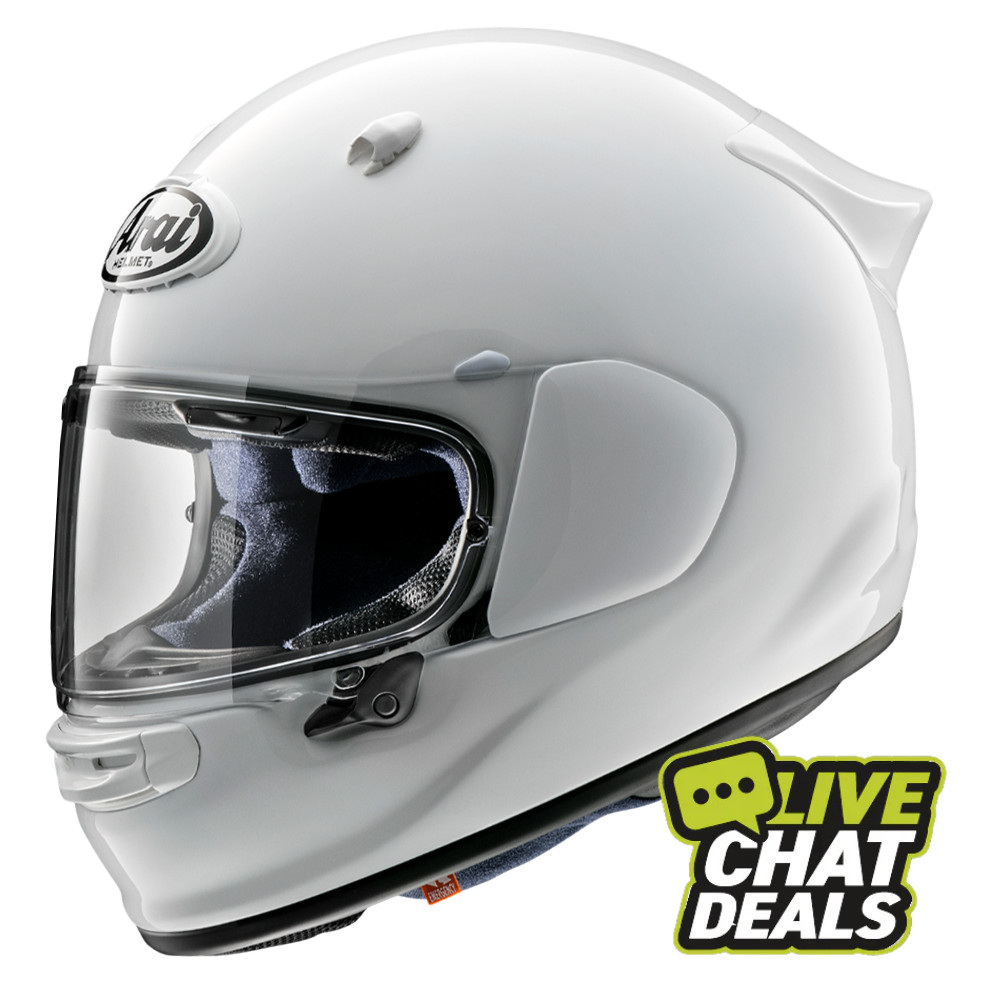
Arai's two flagship full-face helmets are not really competing with each other, they are built for different riding. The Quantic was Arai's first helmet certified to the newer ECE 22.06 standard, and it is pitched as the more versatile of the pair: a road-focused, sport-touring lid tuned for all-day comfort. The RX-7V Evo is the brand's race replica, built around the tucked-in riding position of the track and carrying a SNELL M2020 approval on top of ECE 22.06.
Fit: which head shape each one suits
Arai's whole reputation rests on fit, and it's worth understanding before either of these on price or spec alone. The Quantic runs a round-oval-leaning intermediate oval shell with a slightly wider base than a typical Arai racing shell, which reviewers say makes it noticeably easier to get on and off without loosening the fit once it's on, a small but real difference if you're wearing glasses or getting in and out of the helmet several times a ride. The RX-7V Evo uses Arai's more traditional intermediate oval shape, tightened up for the track, but leans on adjustable cheek and temple pads to dial the fit in around it, so a head shape that doesn't quite suit the base shell has more room to be corrected than on the Quantic.
Neither is a helmet worth buying on spec sheet alone. As with any Arai, the brand's shells run rounder than a lot of European rivals, so try one on if you possibly can before choosing between them.
Ventilation: the clearest difference
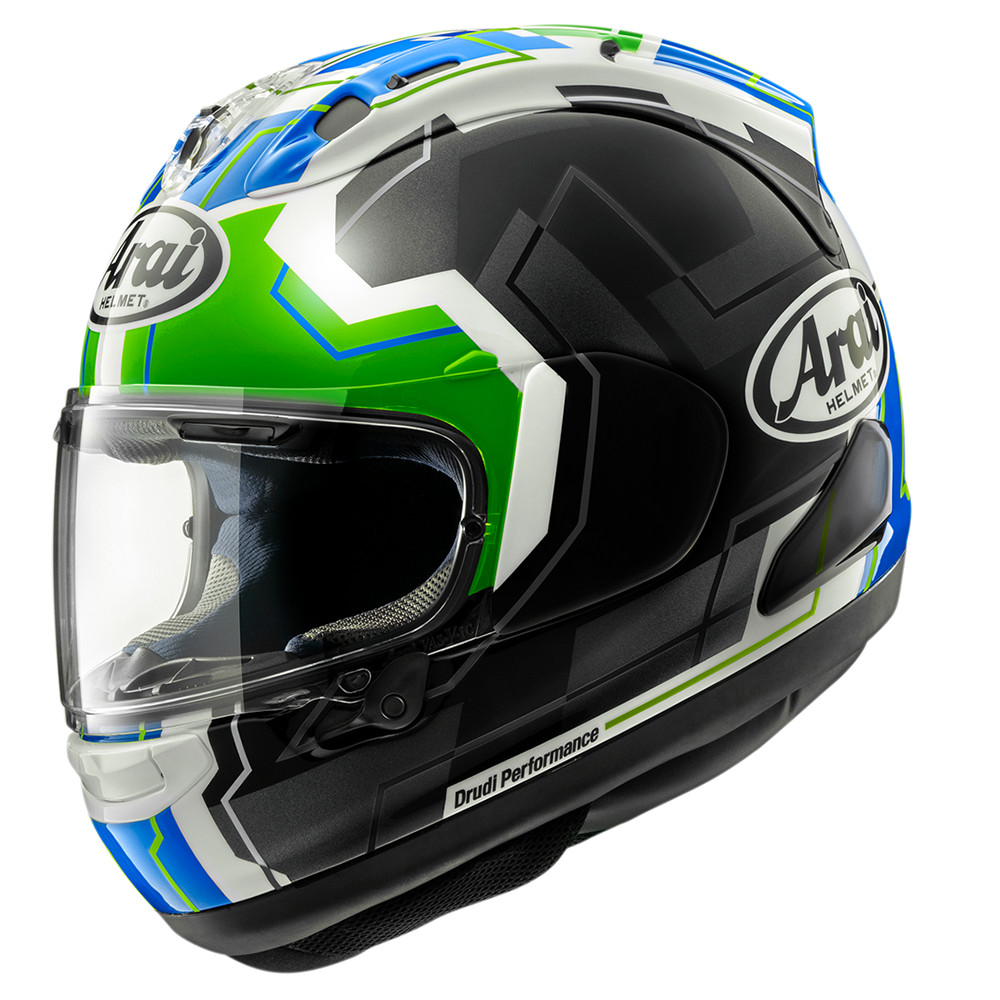
The clearest difference reviewers keep coming back to is ventilation. The RX-7V Evo runs 15 vents and is regularly described as the benchmark for airflow in a full-face helmet, which matters most at track pace or in slow, hot traffic. The Quantic has fewer vents (12: six intake, six exhaust) but is tuned to move air efficiently in a more upright riding position, and reviewers rate it as the quieter, more relaxed helmet of the two for everyday road use.
Noise: closer than the vent-count gap suggests
Vent count doesn't tell the whole story, and noise is where that shows. In SHARP's own noise testing the Quantic averaged around 101dB and is independently rated as one of the quieter helmets tested for road use, with the one caveat that its brow vent picks up a whistle if you ride upright rather than tucked in. It goes notably quieter the moment you drop your head. The RX-7V Evo, despite having far more vents to seal, is also described by reviewers as a genuinely quiet helmet with minimal wind noise, again with its own vent-driven whistle rather than a constant roar. In practice, neither is going to be dramatically louder than the other at legal road speeds; the RX-7V Evo's reputation is really about airflow, not decibels, and good earplugs flatten the gap further on either one.
Both ship Pinlock-ready with the anti-fog insert included rather than sold separately, which isn't a given at this price point. The RX-7V Evo goes further with a genuinely generous spares package in the box (a top-spec Pinlock Max-Vision 120 insert, a spare visor, stickers and lubricant for the moving parts), which is worth weighing against its higher price rather than reading as pure margin.
Shell material: the same composite fibre label, different jobs
Both helmets share the same headline shell material, composite fibre, so it's worth knowing what that label does and doesn't tell you. Composite fibre shells are woven from fibreglass, and often a blend that includes carbon and aramid (Kevlar) fibres, set in resin. Compared with a moulded thermoplastic shell, a composite layup can be made thinner for the same strength, which is the main reason composite-shelled helmets tend to weigh less than thermoplastic ones at a given SHARP-tested protection level, though thermoplastic shells can still perform just as safely at the lower-speed impacts that make up most real crashes.
Interestingly, SHARP records an identical 1.5kg for both the Quantic and the RX-7V Evo, so this isn't a case of one being the lighter helmet. What Arai's layup choice actually buys the RX-7V Evo is stiffness and the extra vent count for track-pace airflow at the same weight, while the Quantic's layup and shape prioritise all-day comfort and a lower price. Same material category and the same SHARP-measured weight, different engineering choices aimed at different riding.
SHARP rating and who each one suits
SHARP rates the RX-7V Evo at 5 stars against the Quantic's 4, and that gap is reflected in the price: the RX-7V Evo costs meaningfully more. If you spend real time at track pace, or simply want the highest-rated lid Arai makes, that is where the extra money goes. If you want Arai's fit and build quality for road use without paying for track-focused ventilation you will rarely use, the Quantic is the more sensible buy.
Worth knowing before you lean entirely on that star score: SHARP isn't beyond criticism. A 2009 University of Birmingham study by Nigel Mills argued its rotational-impact test rests on a flawed mechanics model, and Arai has historically favoured SNELL's own test regime over SHARP's, partly because the two schemes weight impact zones differently. That's exactly why the RX-7V Evo's SNELL M2020 approval is worth something beyond marketing: it's a second, independently run standard rather than the same test repeated. If you want to look past the headline number yourself, SHARP's own page for each model (sharp.dft.gov.uk) also publishes a zone-by-zone breakdown, not just the overall star, so you can see where each helmet actually scored well.
| Model | SHARP rating | Weight | Shell | Fastening |
|---|---|---|---|---|
| Arai Quantic | 4 stars | 1.5kg | Composite fibre | D-Ring |
| Arai RX-7V Evo | 5 stars | 1.5kg | Composite fibre | D-Ring |




Frequently asked questions
Is a 5-star SHARP rating actually safer than a 4-star one?
SHARP tests every helmet at higher impact speeds than the legal ECE minimum requires, across a fixed set of head zones, and the star rating is a direct read-out of how well it performed. A 5-star helmet demonstrably absorbed more of those impacts than a 4-star one did in SHARP's own tests, so within the scheme, a higher star count does mean better measured protection. Fit still matters more than any star rating, but between two helmets that both fit you well, the higher score is the safer choice on the evidence.
Is SHARP's star rating the final word on helmet safety?
No, and it's worth knowing why. A 2009 University of Birmingham study by Nigel Mills argued SHARP's rotational-impact test rests on a flawed mechanics model, and Arai has historically favoured SNELL's own test regime over SHARP's, partly because the two weight impact zones differently, which is one reason the RX-7V Evo carries SNELL M2020 alongside its SHARP score. Treat SHARP as a strong, independently run, government data point rather than the whole picture, and check SHARP's own per-model page (sharp.dft.gov.uk) for the zone-by-zone breakdown behind the headline star if you want more than one number to go on.
Is the RX-7V Evo comfortable for road riding, or only good on track?
It's built around a tucked, sporty riding position first, so reviewers note the brow vent can pick up wind noise if you ride mostly upright. It's far from unusable on the road, but if most of your riding is a relaxed, upright commute rather than a sporty stance, the Quantic is tuned more directly for that position and for comfort over a full day.
Does Arai's SNELL approval mean anything extra over ECE 22.06?
SNELL is a separate, US-based voluntary standard with its own impact testing, and the RX-7V Evo carries both SNELL M2020 and ECE 22.06. It isn't a legal requirement in the UK, where ECE is what matters, but a helmet holding both shows it has been tested against two independent standards rather than just the one it needs to be sold legally. Treat it as a bonus data point, not a replacement for checking the SHARP score.
Do the Quantic and RX-7V Evo take the same size of Pinlock insert?
No, they use different visors, so the Pinlock inserts are model-specific and not interchangeable between the two helmets. Both are sold Pinlock-ready with an anti-fog insert included in the box rather than as a paid extra, which is worth noting given some rivals at this price charge separately for it.
Do I need to replace an ECE 22.05 helmet with an ECE 22.06 one?
No. A helmet approved to ECE 22.05 remains legal to wear and to sell, and the two standards coexist rather than one replacing the other overnight. ECE 22.06 tests a wider range of impact zones and speeds and is worth looking for when buying new, but an existing 22.05 helmet does not need replacing purely because a newer standard exists.
When you know what you want, MotoMiser compares live prices on the same gear across UK retailers, so you can see who has the best deal before you spend.
More from the Blog
- Direct Access Explained: The Fast Route To A Full Bike Licence →
- Your CBT: The Rules, The Kit, and What Gets People Turned Away →
- AGV K1 vs K3: AGV's Entry-Level Helmets Explained →
- AGV K5 vs K6 vs K7: How AGV's Top Road Helmet Evolved →
- Men's Motorcycle Riding Gear: What You Actually Need →
- Women's Motorcycle Gear: Fit Is a Safety Issue →
- Kids' Motorcycle Gear: Don't Buy Big to Grow Into →
- Motorcycle gear buying guides →